ERP Software for Outstaffing: How if.team Helps Control Project Economics
Vladyslav Chesnokov
Copywriter, if.team
Oleh Frolov
CEO, if.team
When a company operates under an outstaffing model, it’s essential to have clear control over how resources are being spent: who is working, how many hours are being tracked, which tasks in the project are billable, and which are not. This is not just about discipline; it’s about project economics — revenue, profitability, and transparency for clients.
For this, a specialized ERP system for outstaffing is needed, one that allows for controlling rates, budgets, and the workload of specialists. This is the system used by the outstaffing company IOD. It provides IT personnel under a time & material model and has organized its operations through if.team.
In this case study, we explain how the company set up processes in the system, how IOD’s clients get real-time access to tasks and reports, and why the platform is suitable for those who provide or receive outstaffing services.
About the client
IOD is an outstaffing company with an international team and years of experience in web development, working remotely across multiple countries. Before focusing on outstaffing, the team completed over 200 projects, ranging from websites and mobile apps to SEO and UI/UX design.
Today, the company employs more than 50 specialists, including developers, project managers, testers, marketers, and designers. However, IOD is not a freelance marketplace. It’s a team that the company builds internally, invests in its development, and provides legal and HR support.
The company needed to ensure effective project and team management, as well as the ability to track workload, tasks, and expenses for each project in real time. That’s why IOD reached out to us and began using the if.team ERP software for outstaffing.
How the if.team ERP software for outstaffing helped optimize project management
The ERP software for outstaffing is particularly relevant for companies operating under the time & material model, where it’s crucial to accurately track costs, team working hours, and financial metrics for each project. Clients need to see a transparent financial picture, have easy access to reports, and receive invoices on time. This is exactly the challenge faced by the outstaffing agency IOD. The team was looking for a solution that would integrate operational processes with financial accounting and allow them to work with clients in real time.
Thanks to the if.team ERP system for outstaffing, the company was able to streamline project management, automate finances, and create an effective system for client collaboration.
Adding clients to the system
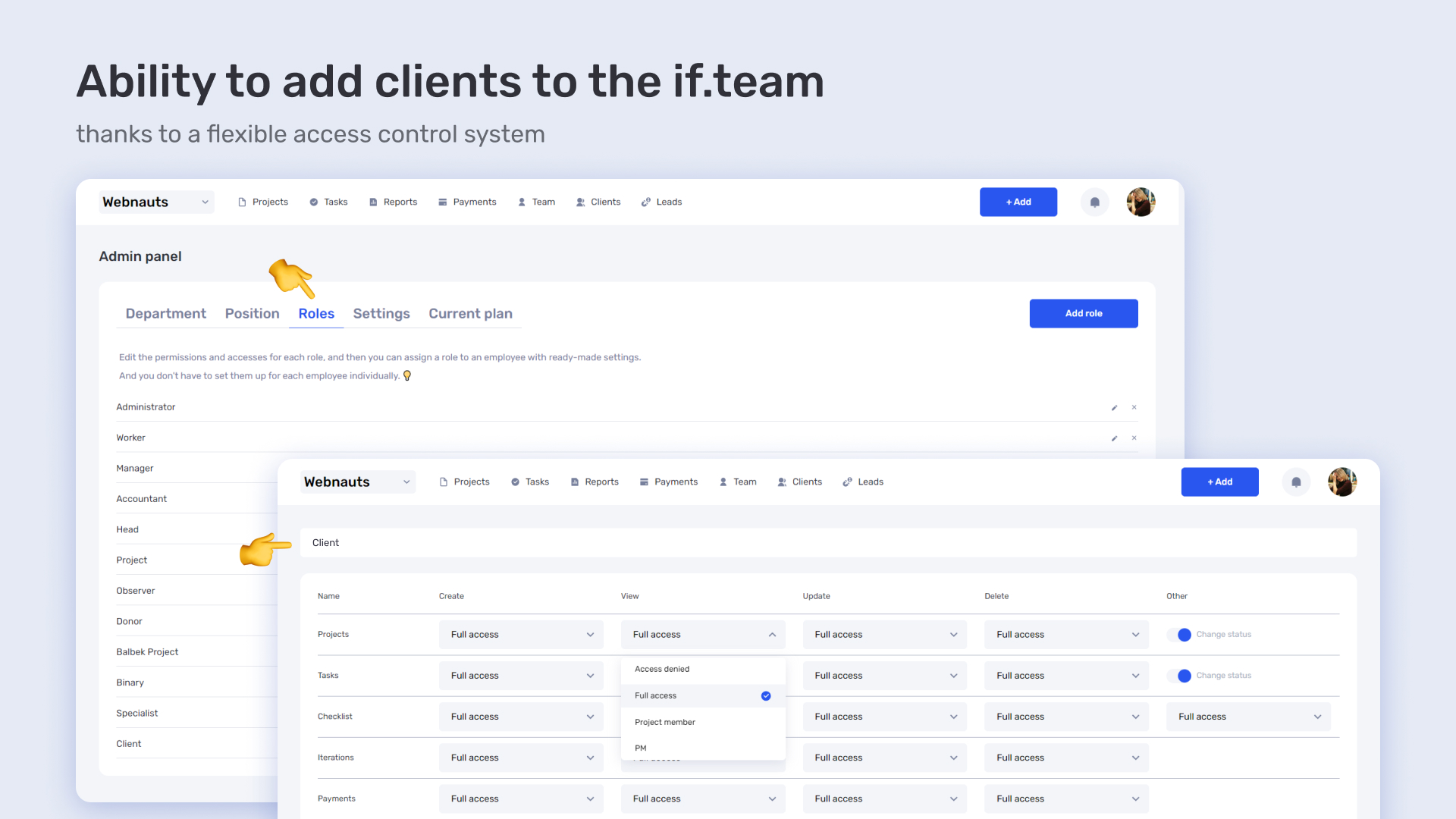
For IOD, it was crucial to have the ability to work effectively with clients in real time. The integration with the if.team ERP software for outstaffing enabled the creation of a user-friendly interface for collaboration, where clients could track task progress and assign new tasks without being overwhelmed with information. These features are essential for any outstaffing agency that aims to provide its clients with convenient control and responsiveness in project execution.
In if.team, flexible access levels can be configured: clients can be allowed to view only the tasks relevant to them or granted full access to all projects. If needed, clients can not only track progress but also independently create new tasks. As a result, the system is used not only by the managers of the outstaffing company but also by the clients themselves, significantly improving interaction and process transparency.
Additionally, IOD clients have access to the up-to-date status of financial settlements, including the ability to view issued and paid invoices, as well as documents and acts related to them. This ensures greater transparency and control on the client’s side, which is vital for maintaining long-term and successful partnerships.
User roles and access rights
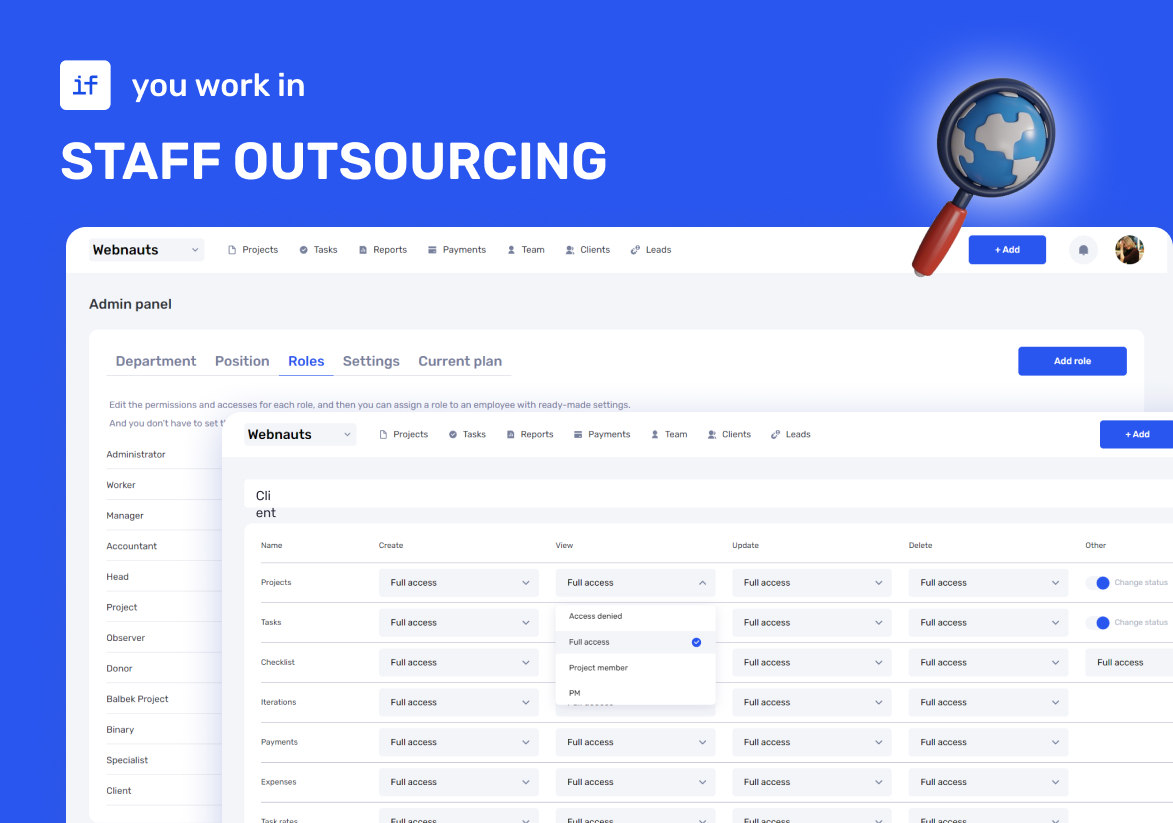
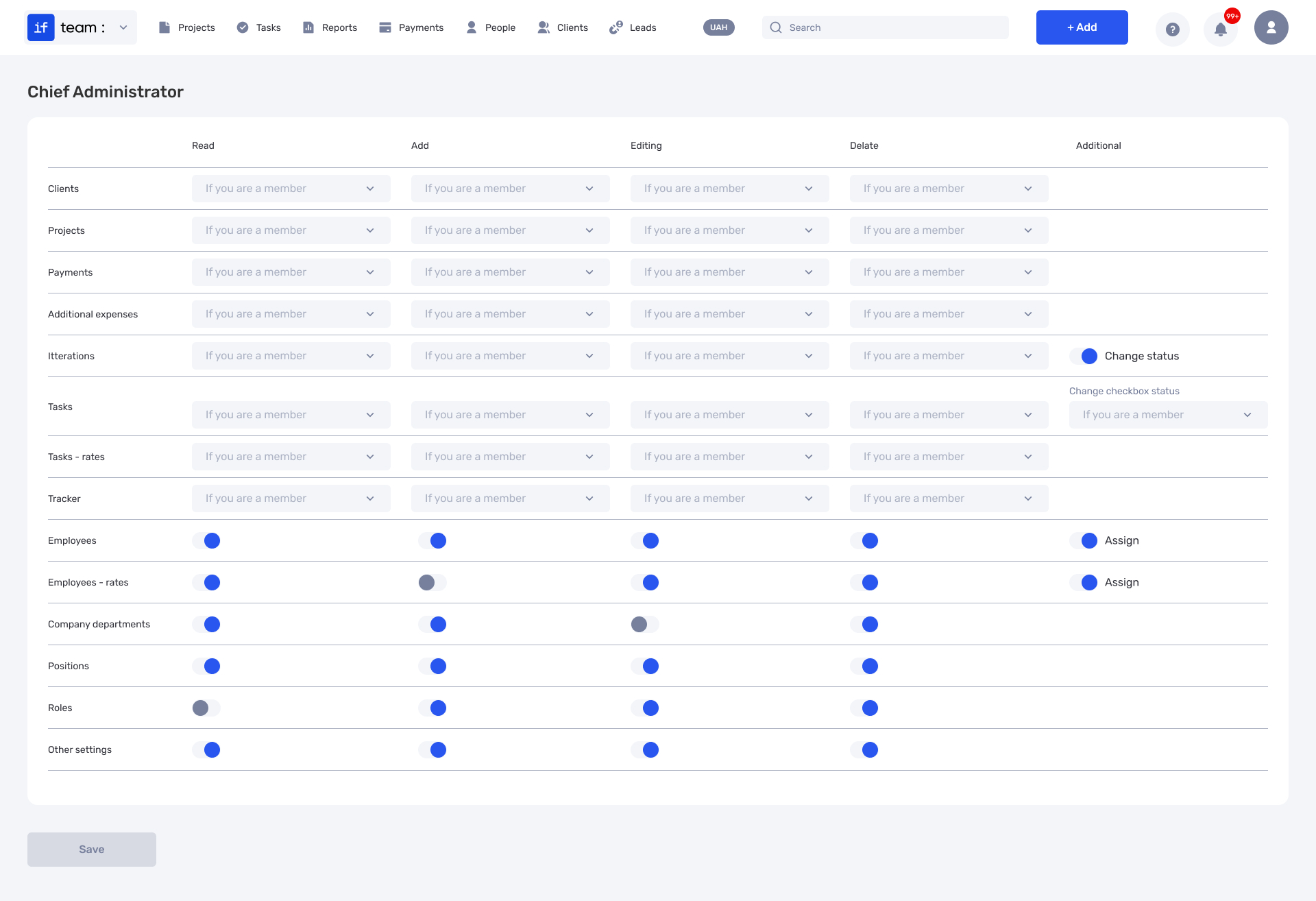
As the number of projects grew and clients were integrated into the system, IOD realized that managing access levels flexibly became critical. The if.team ERP system for outstaffing allows the configuration of who can see what: clients are given access only to the information they need, and teams are shown only relevant tasks. This ensures a convenient and secure collaboration environment without overwhelming users with unnecessary data.
Thanks to the role and access rights settings in if.team, IOD was able to define who has access to specific information both within individual projects and at the company-wide level. Access can be granted not only to tasks but also to project details, client information, leads, reports, and many other sections. This allows for quicker onboarding of new employees, prevents errors due to excessive information, and ensures that clients see only what they truly need. Additionally, different access levels for managers, team leaders, and other roles simplify internal organization within the outstaffing company.
Managing internal and commercial rates
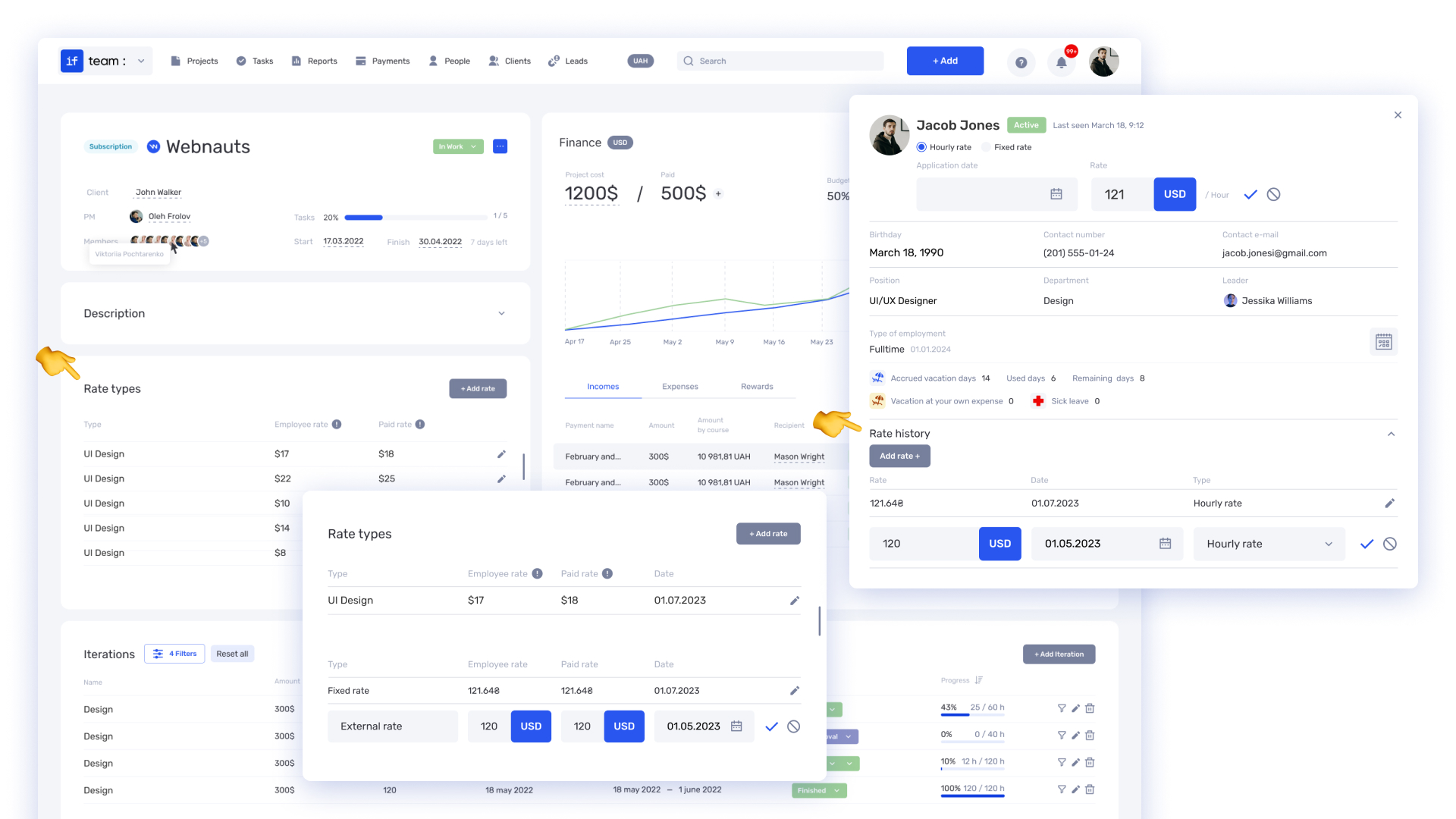
In the ERP system for outstaffing if.team, commercial rates for different tasks and performers can be flexibly configured within the time & material model. This allows creating one or more commercial rates for a project, as well as using them depending on the type of task and performer. Each performer can have their own rate, enabling precise cost estimation for work in every area.
Additionally, the system allows for the use of non-billable rates for tasks that are not chargeable to the client. These tasks won’t be included in the calculations, helping to control the cost of work more accurately and avoid calculation errors.
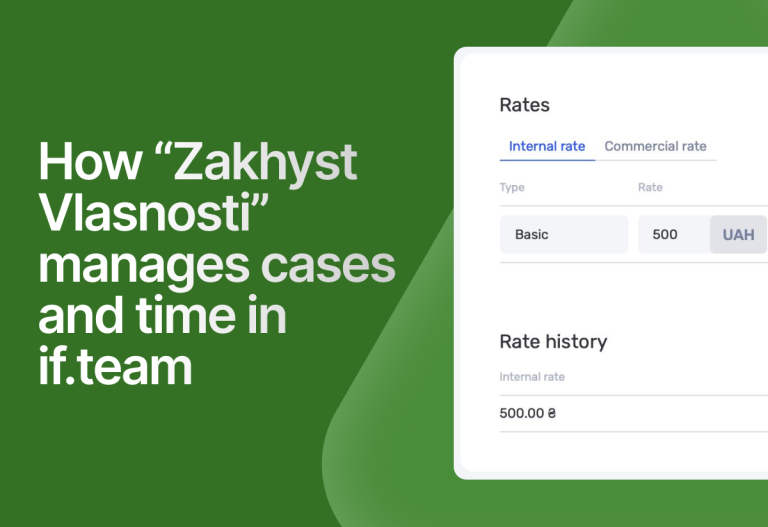
Internal rates, or employee rates, are also easily managed in the ERP system for outstaffing. The rate can be set either monthly or hourly, and if necessary, it can be redefined for each project. This is especially convenient when a different rate is needed for one project compared to another. If the rates are the same for all projects, they can be set once in the employee’s profile, significantly simplifying the process and preventing repeated configurations.
Real-Time Budget Burn Chart
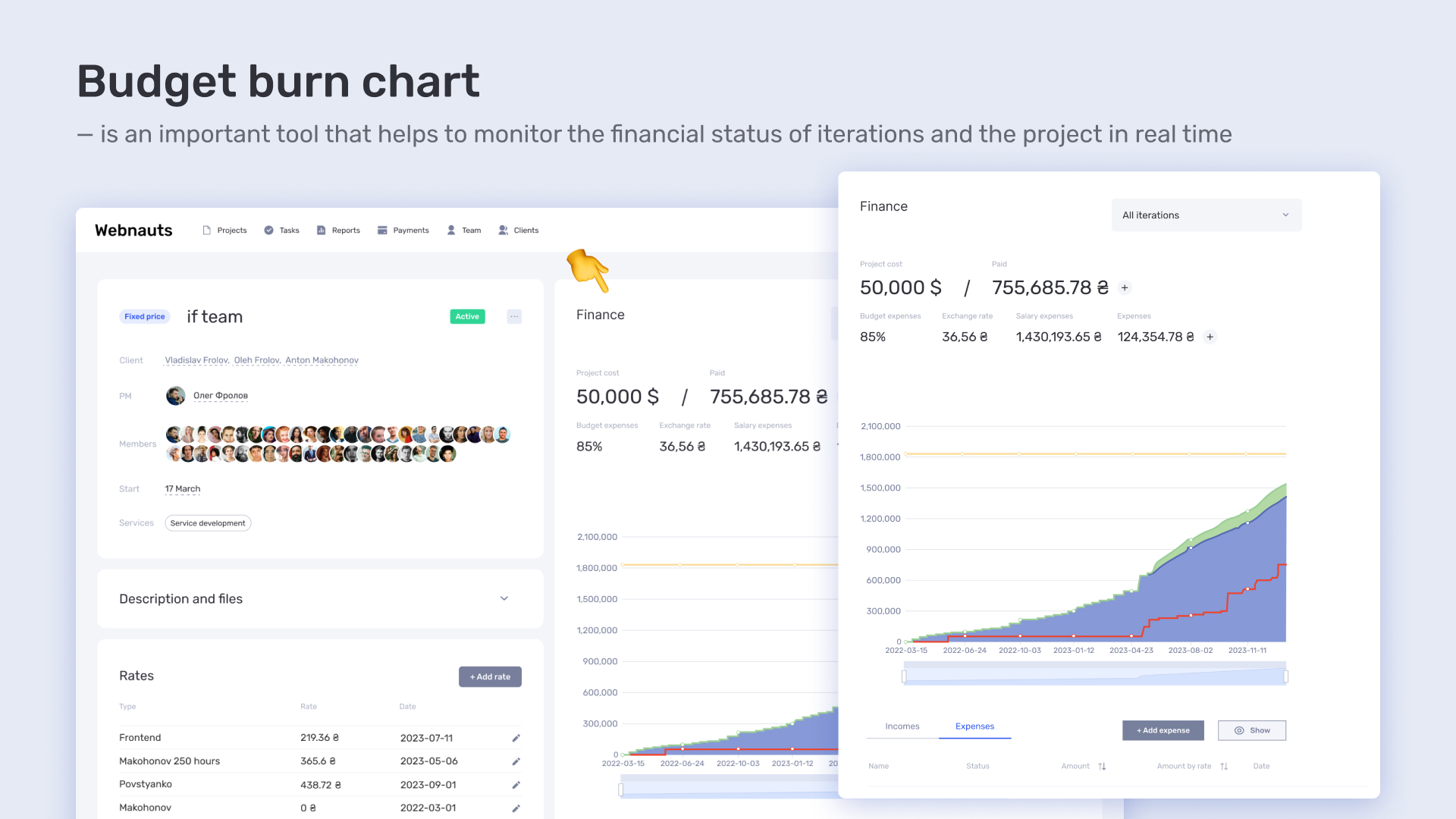
A budget burn chart is a tool that shows how a project’s budget is being spent. It works in real-time, displaying actual expenditures compared to the planned ones. This allows teams to see whether they are exceeding the budget or staying on track. It enables quick responses to deviations and helps make financially sound decisions.
For IOD, it was especially important to track how much had been billed to the client based on various commercial rates and how much had already been invoiced. In the ERP system for outsourcing, if.team, all of this is automated. Projects can be divided into iterations corresponding to payment periods, which allows for clear visibility of the current status of financial settlements. This enables the company to promptly adjust task execution strategies and ensure effective financial management in real time.
Using the ERP system for outsourcing, if.team, provides outsourcing companies with financial transparency and helps them effectively interact with clients.
Iterations and reporting
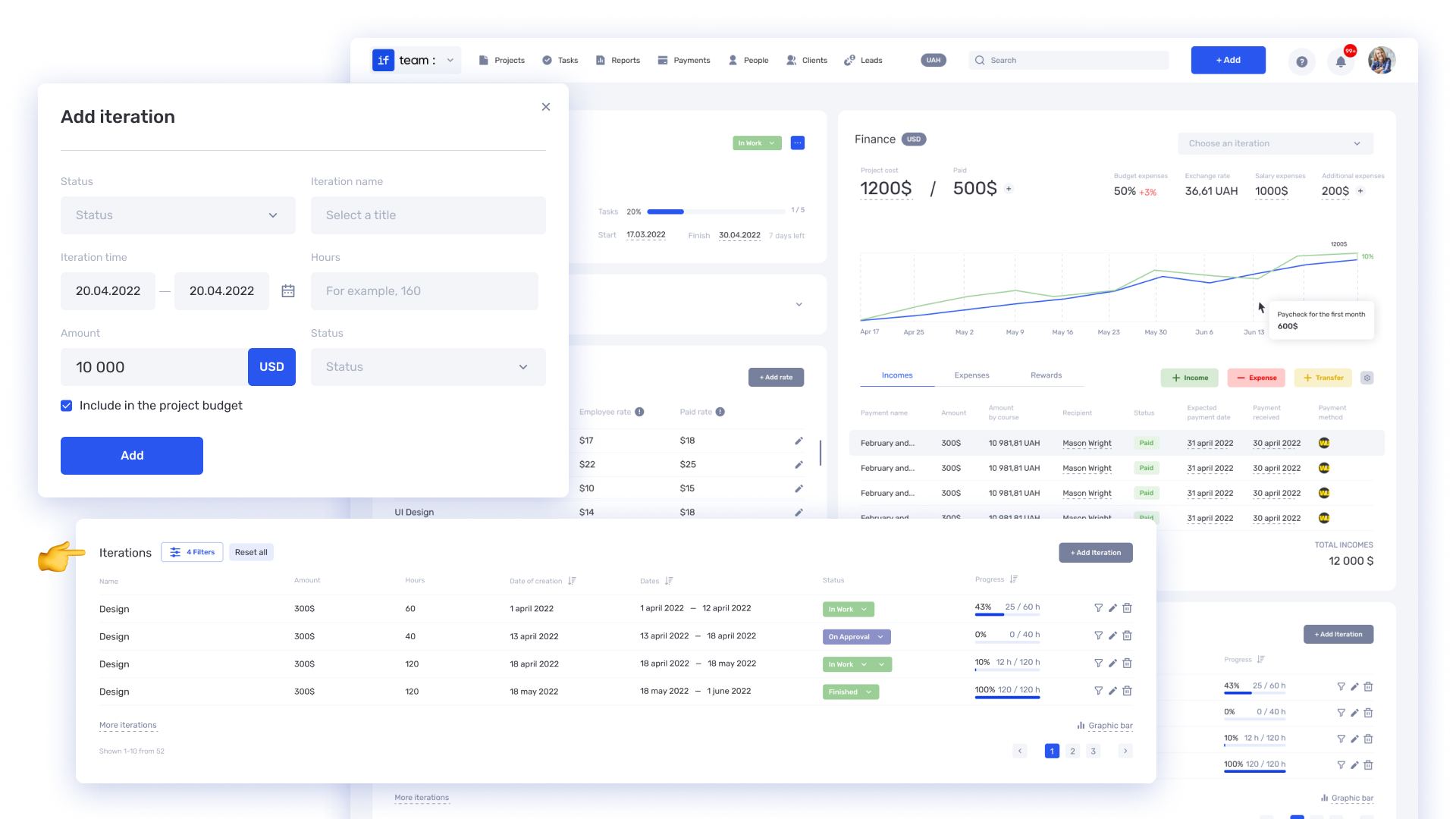
Iterations are separate periods during which the team performs a specific amount of work. They can be tailored to the company’s rhythm: weekly, bi-weekly, monthly, quarterly, etc. Each iteration can be named differently and organized according to the project’s needs. This helps structure the team’s work, plan workloads, and see the progress of task completion. In the ERP system for outsourcing, if.team, iterations are automatically synchronized with financial data, allowing for the most efficient organization of work.
After each iteration is completed, the ERP system for outsourcing, if.team, automatically generates a report with all completed tasks, time spent, and results. This report, along with the invoice, can easily be sent to the client for confirmation of the work done. This approach simplifies accounting, improves transparency in interactions, and helps maintain trust between the outsourcing company and its clients.
At IOD, progress assessments are regularly conducted at different stages of projects, allowing the task execution strategy to be adjusted. With the ERP system for outsourcing, if.team, the company can create clear iterations, enabling the timely adjustment of team work. This is especially important for outsourcing companies that work with clients in real-time.
Reports and Invoices
An important aspect for IOD was the automation of the reporting and invoicing process. With the help of if.team, it is possible to quickly create invoices and control financial transactions. This reduces errors and ensures timely invoicing for clients. For an outsourcing company, this is necessary for proper financial reporting and expense tracking.
In if.team, there is an advanced financial reporting system that covers both individual projects and the company as a whole. All data is updated in real-time, which allows for quick responses to financial changes.
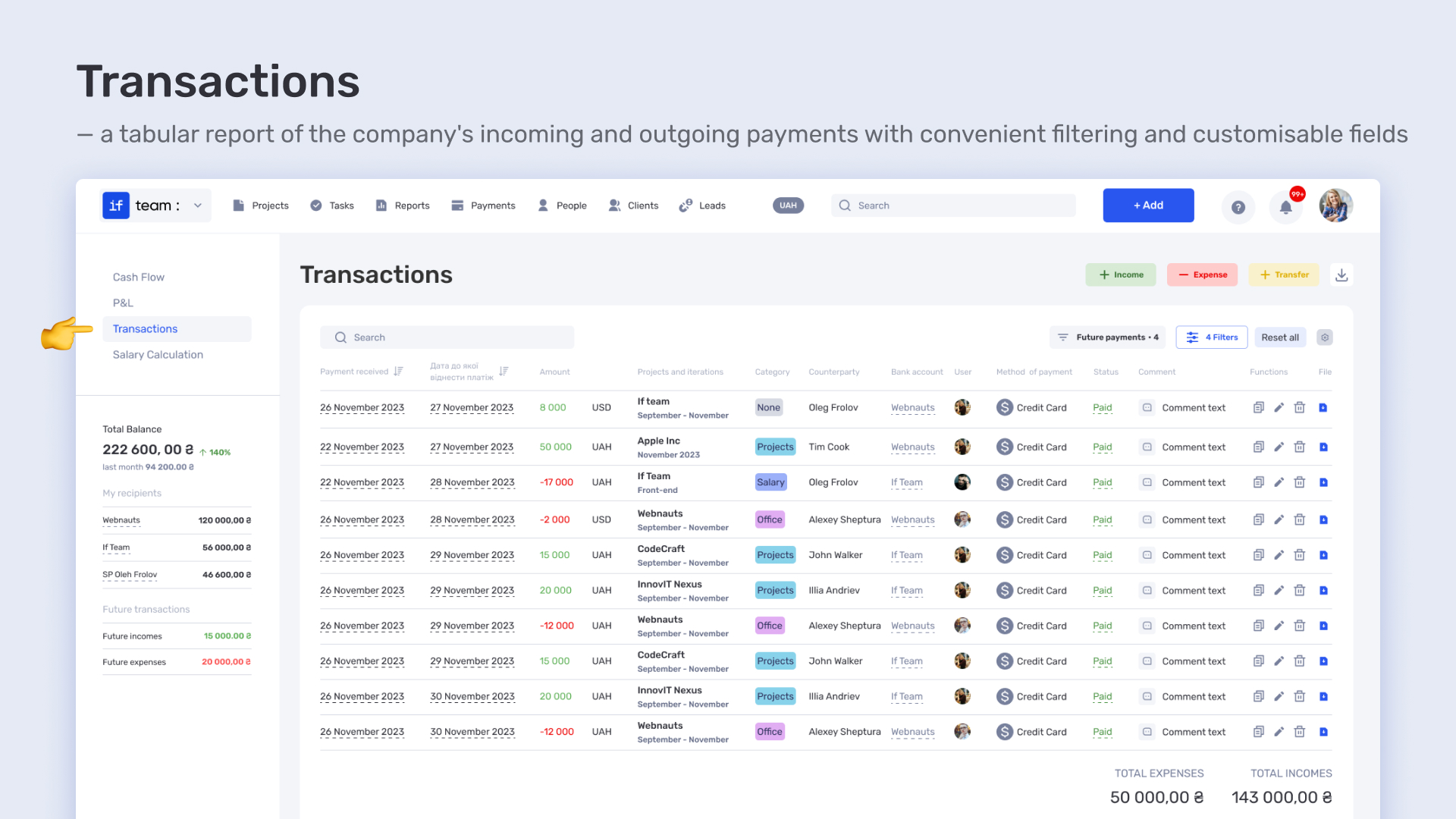
The system includes a “Transactions” module where all incoming and outgoing payments, as well as transfers between accounts, are recorded. This provides an always up-to-date view of the financial status.
Key types of financial reports:
Cash Flow Report — helps to plan finances, avoid cash flow gaps, and control balances across all accounts.
Income and Expenses Report — allows for analyzing profits and expenditures, calculating operational and net profit, planning budgets, and seeing the income structure.
Payroll — enables automatic salary calculation based on a fixed rate or hourly rate and ensures timely payments.
Recurring Expenses — expenses that are automatically tracked (e.g., rent, subscriptions, hosting, etc.), reducing the risk of forgetting them.
This reporting system proved to be especially convenient for IOD as it allowed managers to make quick financial decisions, while accountants could minimize routine manual work.
Internal chats for communication
For quick and effective communication between team members, IOD actively uses internal chats. This allows for easy task discussions, organizing workflows, and getting prompt responses to questions. Such tools are essential for outsourcing companies, where communication is key to successfully completing tasks for clients.
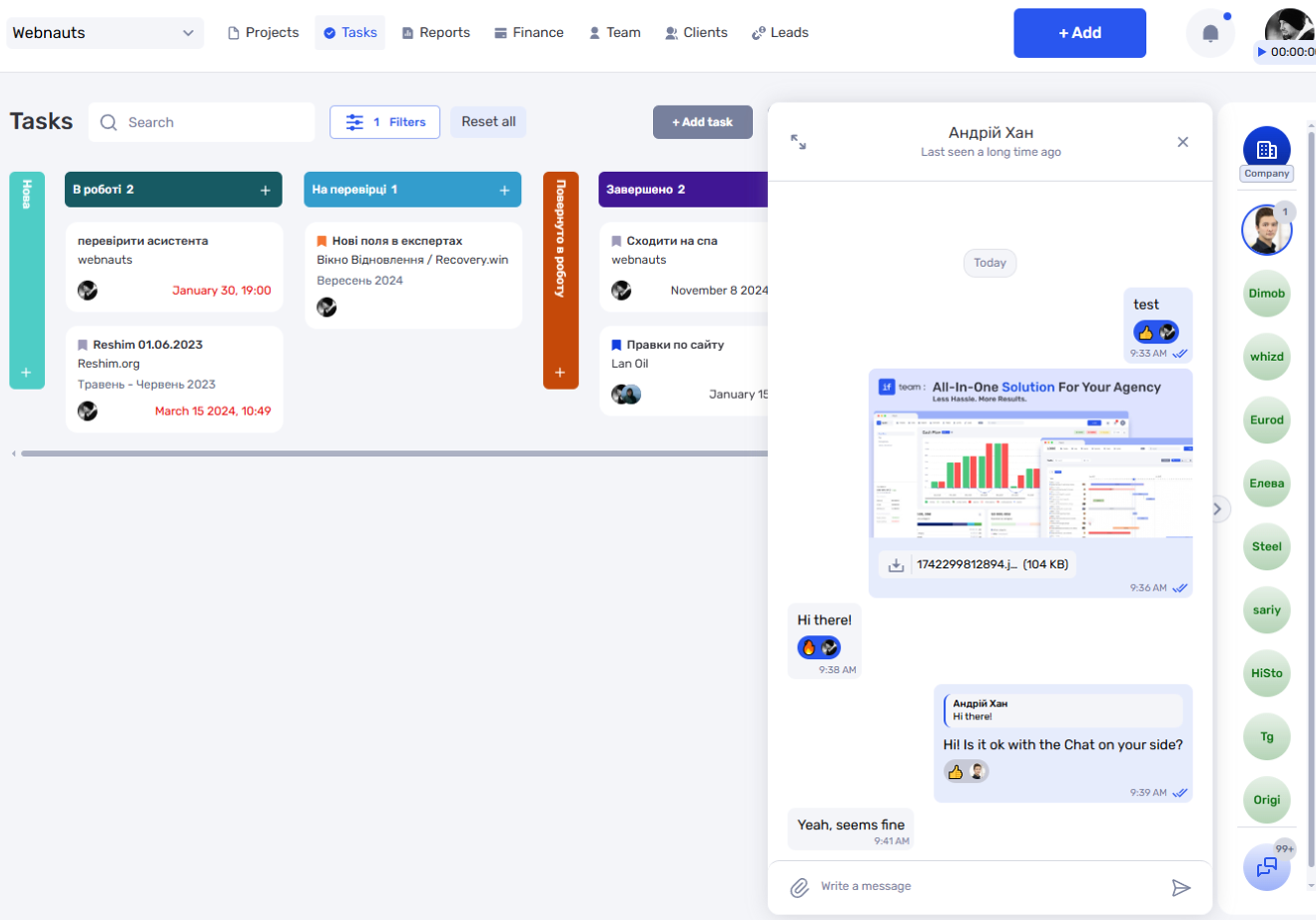
Recently, if.team introduced a new feature — internal chats. Now, task discussions, file exchanges, and quick clarification of details take place directly within the system. This centralizes all communication, reduces the need for external messengers, and simplifies team collaboration.
Three types of chats are available:
Company Chat — a general space for discussing important matters among all employees.
Project Chats — separate channels for teams working on specific tasks or projects.
Private Dialogues — for one-on-one communication without unnecessary participants.
The chat interface is intuitive and familiar to users of modern messengers: it supports file sharing, reactions, replies, and displays the date and time of messages. The panel can be customized — you can work in full-screen, compact, or hidden mode to stay focused. Active conversations are automatically pinned at the top of the chat list for quick access.
Flexible settings allow administrators to define exactly who has access to the chats, which roles can write, edit, or delete messages. This ensures controlled and secure communication, even in teams with a large number of users or involving clients.
How if.team ERP software for outstaffing helps companies maintain financial control and transparency in projects
By using if.team, IOD has significantly improved project management efficiency and ensured maximum transparency for its clients. The platform has automated processes such as budget tracking, report and invoice creation, and facilitated secure and convenient communication both within the team and with clients.
The interface, which allows for setting access levels and working flexibly with projects, helped the company maintain clear control over task execution. At the same time, real-time budget monitoring tools, iterative reports, and automated financial processes significantly reduced the risk of errors and allowed for quick reactions to changes in projects.
Thus, if.team not only simplifies working with clients but also helps outsourcing companies achieve high efficiency and financial transparency in each project.
Working with a large number of parallel cases requires legal teams to plan precisely, control workload, and maintain transparent coordination between employees. A separate challenge is the need to...
In project work, the connection between processes is critical — how tasks are created, how work is executed, and how this is reflected in project economics, either in real time or...
As the number of players and operational complexity grew, the company needed to bring all processes into a single system in order to manage operations centrally and get real-time financial visibility...